

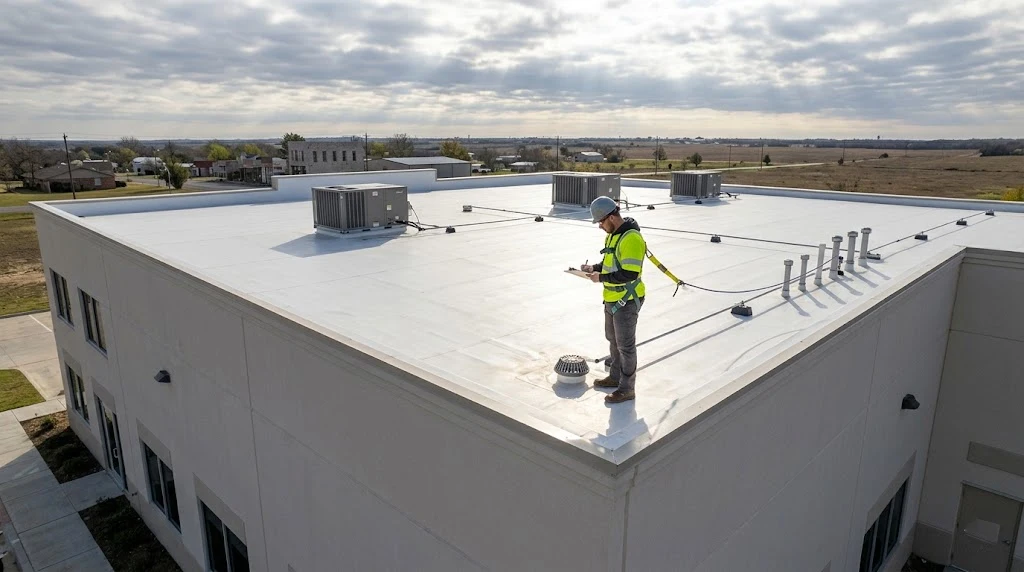
A commercial roof maintenance checklist for Tolar businesses should include twice-yearly inspections, drainage system checks, flashing and membrane evaluations, debris removal, HVAC equipment reviews, and post-storm assessments. North Texas weather — including hail, high winds, and intense summer heat — makes proactive roof maintenance especially critical for local business owners.
If you own or manage a commercial property in Tolar, Texas, your roof faces some serious challenges every single year. Between the blazing summer heat, sudden hailstorms, high winds, and the occasional hard freeze, North Texas weather doesn’t go easy on any building. That’s why following a solid commercial roof maintenance checklist for Tolar businesses isn’t just smart — it could save you thousands of dollars and keep your operations running without interruption.
The good news is that staying on top of your roof doesn’t have to be complicated. With a clear routine and a little attention each season, you can catch small problems before they turn into expensive disasters.
Why Tolar Business Owners Can’t Ignore Roof Maintenance
Tolar sits in Hood County, right in the heart of North Texas, where severe weather is a regular part of life. Texas leads the nation in major hail events, and North Texas corridors are among the most frequently affected areas in the entire state. That means local business owners are dealing with more weather-related roof stress than most.
Beyond hail, summer temperatures in this region regularly push past 100°F for weeks at a time. Extreme heat causes asphalt shingles to deteriorate rapidly, and intense UV radiation breaks down roofing materials, making them more vulnerable when the next storm rolls through.
The financial stakes are real. Ignoring small issues — a cracked seam here, a slow drain there — can quickly compound into structural water damage, interior destruction, and business interruption. Without a regular commercial roof maintenance plan, small issues can escalate into major structural problems that are far more expensive to fix.
A consistent maintenance routine is your best defense.
How Often Should You Inspect a Commercial Roof in Tolar?
The baseline recommendation from roofing professionals is clear. You should inspect your roof at least twice a year, preferably in the spring and fall. Given the extreme weather conditions in Texas, it’s also wise to schedule additional inspections after severe storms or high winds.
Spring inspections help you identify any damage left behind by winter. Fall inspections prepare your building for the cold months ahead. And after any significant hail event, a prompt post-storm check is essential — commercial insurance claims in Texas require documented findings filed within 12 months of the storm, and adjuster assessments frequently undercount damage that a trained roofing professional would identify.
Don’t wait for a drip from the ceiling to motivate you. By then, water has already been sitting somewhere it shouldn’t be.
The Complete Commercial Roof Maintenance Checklist
Start With a Full Exterior Inspection
Walk the perimeter of your building and look at what you can see from ground level before you ever step foot on the roof. Visible signs of trouble — sagging sections, discoloration on walls, lifted flashing along the edges — are often easy to spot from below.
When you do get on the roof, take your time. Look for tears, holes, or loose parts, and check for any cracks, blisters, or damage to the roofing membrane. On flat or low-slope roofs, which are common for commercial buildings, membrane damage can be subtle. A small blister today becomes a full breach after the next hailstorm or heavy rain.
Pay close attention to any areas around rooftop equipment, vents, skylights, or HVAC units. These penetrations are where most leaks originate.
Inspect and Clear the Drainage System
Water is the single biggest enemy of any commercial roof. If it sits on your roof for more than 48 hours, it starts doing damage. Ponding water can accelerate roof deterioration and compromise its structural integrity. Identify areas of ponding water and take steps to improve drainage, such as installing tapered insulation or adding roof drains.
Start by clearing debris from all roof drains, gutters, and downspouts. In North Texas, wind carries leaves, dirt, and plant material onto rooftops regularly, especially in the fall. Check the pipes leading away from the roof to make sure they’re clear and not damaged, and inspect overflow drains to confirm they’re ready if the main drains get overwhelmed.
Clean gutters aren’t just about the roof — clogged downspouts can cause water to back up against your building’s foundation, causing problems well beyond the roofline.
Check Flashing and Seals Carefully
Flashing is the metal or sealant material used wherever your roof meets a vertical surface — walls, parapets, curbs, chimneys, and around any penetration. It’s one of the most important parts of your roof system, and also one of the most frequently overlooked.
Flashing failures around roof penetrations can become leak points if they aren’t sealed properly. During each inspection, press gently along flashing edges to check for separation or lifting. Look for cracked caulk, rust spots, or areas where the sealant has dried out and pulled away from the surface.
In Tolar’s climate, the constant cycle of summer expansion and winter contraction puts real stress on these sealed connections. Resealing flashing at the first sign of wear is a simple task that prevents a massive headache.
Evaluate the Roof Membrane and Surface Condition
The membrane is the waterproof skin of your commercial roof. Depending on your building, this might be TPO, EPDM, modified bitumen, or built-up roofing. Each material has its own vulnerabilities, but all of them need regular attention.
TPO roofs can experience membrane shrinkage that stresses seams and attachments, as well as welded seam separation that often appears with aging or improper installation. Surface cracking from UV exposure can also shorten the roof’s lifespan significantly.
For metal roofs, corrosion can develop over time — especially near seams or fasteners — and loose fasteners or panels may appear due to expansion and contraction cycles.
The key is knowing your roof type and understanding what to look for. When in doubt, bring in a professional who specializes in that specific system.
Assess Rooftop HVAC and Equipment
Most commercial buildings in Tolar have rooftop HVAC units, exhaust fans, or other mechanical equipment. These systems sit directly on the roof surface and can cause real damage if not properly maintained.
Regularly inspect rooftop HVAC units for signs of leaks or corrosion and promptly address any issues to prevent further damage to your roof. Also make sure that equipment vibration hasn’t loosened any fasteners or punctured the membrane around unit bases.
Check that equipment curbs — the raised platforms that units sit on — are properly sealed and free from cracking. Water loves to find its way around poorly sealed curbs, especially during heavy Texas downpours.
Remove Debris Regularly
This sounds basic, but debris accumulation is one of the most common causes of drainage problems on commercial roofs. Branches, leaves, plastic, and dirt can build up faster than you’d expect, especially after a storm.
If your rooftop has parapets or raised surfaces, debris removal needs to happen more frequently than on a flat roof. HVAC areas are also likely to catch leaves and trash. Make debris clearing a monthly habit, not just a seasonal one. It takes minutes and prevents hours of repair work.
Inspect Interior Spaces for Early Warning Signs
Maintenance doesn’t only happen on the roof itself. Walk through your building regularly and look up. Water stains on ceiling tiles, bubbling paint, soft drywall, or musty odors in certain areas are all signs that moisture has already found a way inside.
Check inside your building for any signs of water damage or leaks. Catching interior signs early lets you trace the source before it spreads to insulation, structural elements, or electrical systems.
After a Hailstorm: What Tolar Business Owners Should Do
Tolar businesses need a specific plan for post-storm action. After any significant hail event or severe thunderstorm, don’t wait for your next scheduled inspection. Get on the roof or call a contractor within a few days.
Any significant hail event should trigger an additional roof assessment. Property owners who have a contractor relationship in place before damage occurs are in a significantly better position than those who start calling around after the fact — especially in a market where demand spikes immediately after severe weather events.
Document everything with photos. Write down dates. Keep a file. This documentation becomes critical if you need to file an insurance claim, and it gives you a clear picture of your roof’s health over time.
The Value of Professional Roof Inspections
While it’s smart to do your own visual checks between scheduled visits, professional inspections go deeper. Routine, scheduled commercial roof inspections are your first line of defense. Have a professional inspect your roof at least twice a year and always after any severe weather. A roofing specialist will pay close attention to membrane condition, flashings, rooftop equipment, and drainage systems.
A trained eye catches things that most property managers miss — small seam separations, micro-cracks in the membrane, or barely-visible rust starting around fasteners. Catching these issues early is far less expensive than emergency repairs later.
Keep Records of Every Inspection and Repair
One part of roof maintenance that’s easy to skip — and costly to ignore — is documentation. Every time you inspect your roof, write down what you found. Every time a repair is made, log the date, the issue, and what was done.
A roof asset management program acts like a health record for your roof. Keeping detailed records of inspections, repairs, and any replacements helps you monitor the roof’s condition over time and plan for any needed repairs before they become urgent.
Good records also help when budgeting for the future. They tell you how old certain repairs are, when the membrane was last treated, and whether recurring issues in the same spot might point to a deeper structural problem.
A Practical Seasonal Approach for Tolar Businesses
The best way to think about commercial roof maintenance is to break it into seasons. Spring is the time to assess winter damage, clear winter debris, and check seals after temperature swings. Summer calls for heat and UV monitoring, proper ventilation checks, and keeping drainage clear during heavy rain season.
Fall means preparing for cooler weather — resealing vulnerable areas, trimming nearby trees before winter winds hit, and scheduling your professional inspection before the year ends. Winter poses risks like ice dams and strong winds, so inspecting roof edges and gutters to prevent ice buildup is critical in the colder months.
Each season brings different threats, but the core principles stay the same: look often, fix early, and document everything.
Final Thoughts
Your commercial roof is one of the most important — and most neglected — parts of your building. For Tolar businesses operating in the middle of some of Texas’s most challenging weather territory, proactive maintenance isn’t just a good habit. It’s a financial necessity.
Following this commercial roof maintenance checklist for Tolar businesses gives you a structured, reliable way to stay ahead of small problems before they turn into costly emergencies. Inspect twice a year, check after every major storm, keep your drains clear, and build a relationship with a trusted local roofing contractor before you desperately need one.
Your roof protects everything inside your building — your inventory, your equipment, your employees, and your customers. Give it the attention it deserves, and it will keep doing its job for years to come.
