

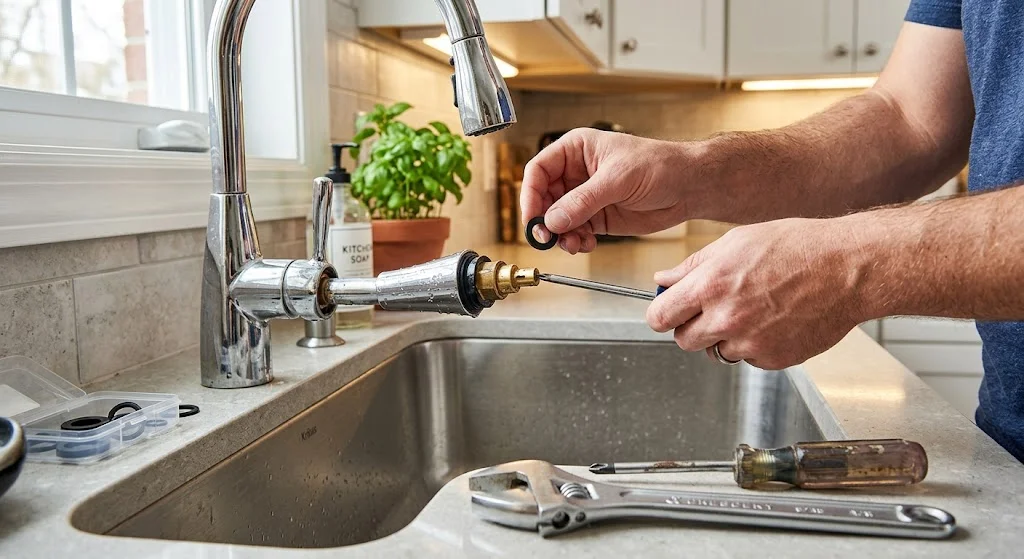
Why You Should Fix That Drip Right Now
That slow, steady drip from your kitchen faucet might seem harmless — but it is costing you money. A single leaky faucet can waste up to 3,000 gallons of water per year, driving up your utility bills without you even noticing. Beyond the cost, the constant moisture can damage your sink, countertop, and cabinet over time.
The good news? Most kitchen faucet leaks are caused by a worn-out washer, O-ring, or cartridge — and replacing one of these parts is a straightforward DIY job. No plumber required. With basic tools and about an hour of your time, you can stop that drip for good.
Tools & Materials You Will Need
Before you get started, gather everything listed below. Having these on hand saves you from mid-job trips to the hardware store.
| Tool / Material | Purpose | Notes |
| Adjustable Wrench | Loosening nuts & fittings | Medium size works for most faucets |
| Phillips & Flat Screwdriver | Removing handle screws | Keep both types handy |
| Replacement Washers / O-rings | Fix the actual leak source | Match to your faucet brand/model |
| Replacement Cartridge (optional) | For cartridge-type faucets | Check faucet brand before buying |
| Plumber’s Grease | Lubricate rubber parts | Silicone-based grease recommended |
| Bucket or Towel | Catch residual water | Place under sink before starting |
| Needle-nose Pliers | Grip small components | Optional but very helpful |
Step 0: Preparation — Safety First
⚠️ Turn Off the Water Supply Before Anything Else
Skipping this step leads to a flooded kitchen. Here is how to do it safely:
- Look under the sink for two shut-off valves — one for hot water, one for cold.
- Turn both valves clockwise until they stop. This cuts off water to the faucet.
- Turn on the faucet to release any remaining water pressure in the line.
- Place a bucket or old towel under the sink to catch drips from the pipes.
Pro tip: If you cannot find individual shut-off valves, turn off the main water supply to your home instead.
Step-by-Step Guide to Fixing Your Leaky Kitchen Faucet
Step 1: Remove the Faucet Handle
- Look for a decorative cap on top of the handle. Pop it off with a flat screwdriver.
- Underneath, you will find a screw (Phillips head). Remove it completely.
- Pull the handle straight up and off. If it is stiff, gently wiggle it — do not force it hard.
- Set the handle and screw aside in a safe spot where they will not roll away.
Step 2: Take Apart the Stem or Cartridge
- Once the handle is off, you will see either a packing nut, stem, or cartridge depending on your faucet type.
- Use your adjustable wrench to unscrew the packing nut (turn counter-clockwise).
- Pull out the stem or cartridge straight up. Some cartridges have a retaining clip — use needle-nose pliers to remove it first.
- Take a photo of how everything looks before removing parts. This makes reassembly much easier.
Step 3: Inspect the Parts — O-rings and Washers
This is where you find the culprit:
- Worn washer: Located at the bottom of the stem. If it looks flat, cracked, or hardened — this is your leak.
- Damaged O-ring: Thin rubber rings on the stem. If they look stretched, cracked, or rough to the touch — replace them.
- Corroded cartridge: If the cartridge itself is cracked or discolored, the whole unit needs replacing.
Take the old washer or O-ring to a hardware store to find an exact match by size.
Step 4: Replace the Damaged Part
- Remove the old washer — it is held by a brass screw at the bottom of the stem. Unscrew it.
- Slide off the old O-rings from the stem grooves.
- Apply a thin coat of plumber’s grease to the new O-rings before installing them. This prevents premature wear.
- Seat the new washer in place and tighten the brass screw firmly — but not too tight (see Common Mistakes below).
- If replacing a cartridge: simply insert the new one in the same orientation as the old one. Refer to your photo from Step 2.
Step 5: Reassemble the Faucet
- Slide the stem or cartridge back into the faucet body, making sure it is properly aligned.
- Hand-tighten the packing nut first, then give it a quarter-turn with the wrench. Do not over-tighten.
- Place the handle back on and reinstall the screw.
- Snap the decorative cap back in place.
Step 6: Test for Leaks
- Slowly turn the shut-off valves back on (counter-clockwise). Open hot and cold separately.
- Let water flow for 30 seconds while watching the base and spout carefully.
- Check under the sink too — run your hand along the supply lines to feel for any moisture.
- If there is no dripping: great, you are done! If the drip continues, go back and check the washer or O-ring fit.
Once your faucet is fixed, make sure to also learn how to clean your kitchen sink drain to keep your entire setup running smoothly.
Common Mistakes to Avoid
Even a simple repair can go wrong. Watch out for these:
- Over-tightening bolts and nuts: The most common DIY mistake. Too much force cracks the seat or strips the threads — finger-tight plus a quarter-turn is usually enough.
- Buying the wrong replacement part: Washers and O-rings are not universal. Always bring the old part to the store or note your faucet brand and model number before buying.
- Skipping the water shut-off: Even if the faucet looks dry, residual pressure in the line can cause a sudden burst of water.
- Forgetting to grease new O-rings: Dry rubber wears out much faster and can cause another leak within months.
- Reassembling in the wrong order: Take a photo at every disassembly step. A reversed cartridge can cause the hot and cold handles to work backwards.
You Did It — Now Keep That Faucet Running Tight
Fixing a leaky kitchen faucet is one of the most satisfying home repairs you can do yourself. You saved water, saved money on your bill, and avoided a costly plumber visit — all in under an hour.
Most faucet issues come down to a single worn part, and now you know exactly how to find it and replace it. The next time you hear that drip, you will know exactly what to do.
Did this guide help you fix your faucet? We would love to hear how it went! Drop a comment below, share your experience, or let us know if you ran into a situation not covered here. Your feedback helps us make our guides better for every homeowner.
— ZilloHome Editorial Team
