

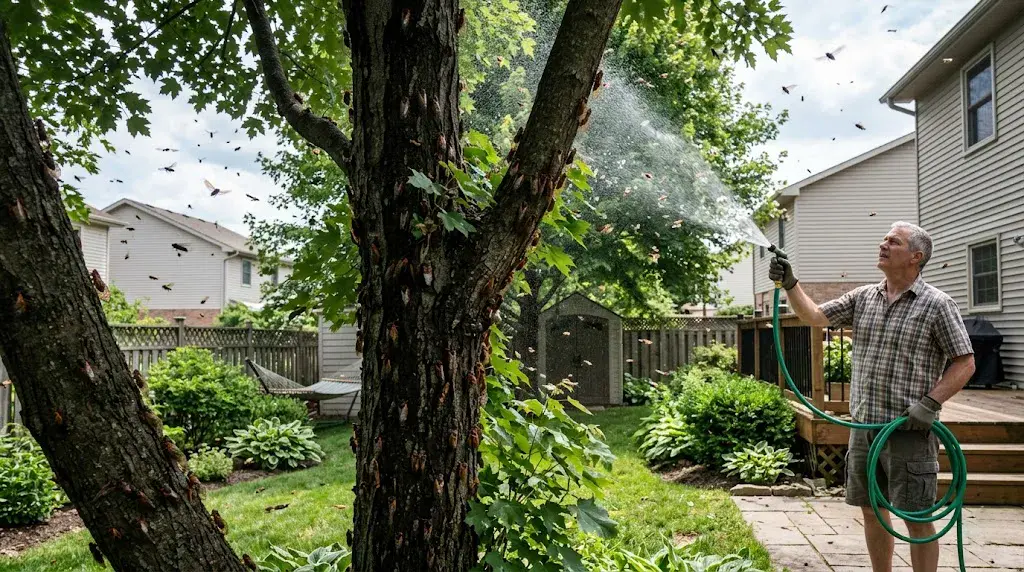
To get rid of cicadas, focus on physical barriers like protective netting over plants, spraying them off with a garden hose, sealing entry points into your home, and reducing outdoor lighting at night. Pesticides are largely ineffective and can harm beneficial insects. Most cicada swarms naturally end within four to six weeks.
If you’ve stepped outside recently and felt like you walked into a nature documentary, you’re not alone. Cicadas are loud, plentiful, and a little unsettling — especially when they show up by the millions. The good news? Learning how to get rid of cicadas is more about managing your space than waging a full-scale war on the insect world. And most of what works is simpler than you’d think.
Let’s break it all down.
Why Cicadas Are Suddenly Everywhere
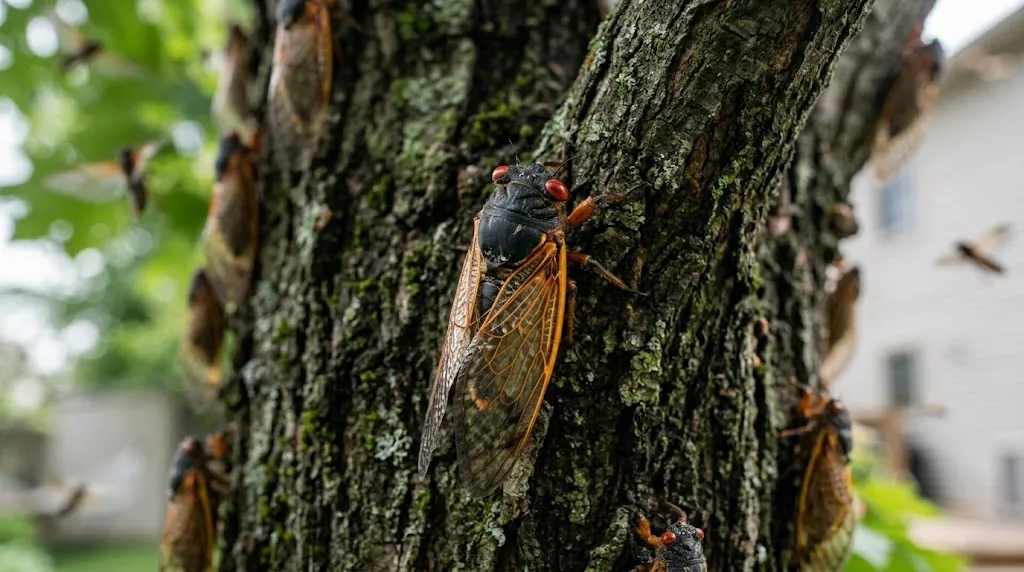
Cicadas come in two main types: annual cicadas, which emerge every year, and periodical cicadas, which stay underground for 13 or 17 years before surfacing in massive numbers. Annual cicadas tend to show up in late spring and into summer. Periodical cicadas, with their distinctive red eyes and orange-veined wings, are the ones that cause the dramatic swarms people remember for decades.
Adult annual cicadas have stout, dark green-black bodies well over an inch long, with wings that can be two to three times that length. Periodical cicadas are black with large, protruding orange-red eyes.
These insects are not dangerous. Cicadas don’t bite, sting, cause rashes, or transmit disease. According to the EPA, they can actually benefit the environment by aerating lawns, improving water filtration, and providing nutrients to the soil as they decompose. Still, when millions of them are screaming outside your bedroom window, “beneficial to the ecosystem” feels beside the point.
Do Pesticides Work on Cicadas?

Here’s the honest answer: not really.
Pesticide applications aren’t effective at eliminating cicadas and can actually do more harm than good because they may deter beneficial insects if applied incorrectly. The EPA doesn’t recommend pesticides to get rid of cicadas — there are simply too many, and the chemicals can also harm beneficial insects.
Pesticides also make matters worse by eliminating cicadas’ natural predators, and when cicadas are exposed to pesticides, that harm gets transferred up the food chain.
So save your money and skip the chemical sprays. There are far more effective strategies that won’t cost you much or hurt your garden in the process.
How to Get Rid of Cicadas in Your Yard
Use a Garden Hose
If cicadas are annoying you in your yard, try turning on the water hose and spraying them away. Just be prepared to repeat this often, since more will arrive throughout the season. It won’t eliminate them permanently, but it gives you some immediate relief when the noise or sheer numbers get overwhelming.
Protect Your Plants With Netting
Cover the entire canopy of the plant with mesh netting, making sure it reaches the ground on all sides. Secure it at the base with a stake to prevent cicadas from entering underneath. This method works by physically blocking cicadas from accessing the plants they prefer for egg-laying.
This is one of the most effective things you can do, especially for young trees and shrubs that are most vulnerable to damage from egg-laying females.
Mow at the Right Time
When mowing your lawn, it’s ideal to do it in the early morning or at dusk when cicadas are least active. Male cicadas respond to vibrations and may be drawn toward a running lawn mower during the day. Adjusting your schedule by even an hour or two can make a noticeable difference.
Trim Back Branches Near Your Home
Trimming tree branches, cleaning out gutters, and protecting trees with netting or foil barrier tape can discourage cicadas from clustering near your house. Spraying down tree and shrub branches with water also makes the habitat less attractive to them.
How to Keep Cicadas Out of Your Home
The good news here is that cicadas don’t actually want to be inside your house. Cicadas are unlikely to intrude into your home because they feed on the sap of trees. But they do sometimes wander in by accident.
Keep windows and doors closed, seal any significant gaps, and ensure your screens are intact. These large insects can’t squeeze through small cracks the way ants or roaches can — if a cicada ends up inside, it likely wandered in through an open door or window.
Keeping outdoor lights off and curtains closed at night also helps, since cicadas are attracted to light just like most other insects.
If one does end up inside, don’t panic. Simply relocate it outside by catching it in a cup or container, or use a vacuum to extract it from hard-to-reach spaces. It will likely make a loud noise when you grab it, but that’s all.
How Long Does a Cicada Swarm Last?
This is probably the most comforting piece of information in this entire article.
Adult cicadas only live about two to six weeks above ground. While that may not seem short when they’re making noise right outside your house, periodical cicadas don’t typically sing at night, so you’ll at least get some quiet after dark.
The best approach, according to many entomologists, is simply to let them get on with their lives and enjoy the spectacle. They’ll only be around for a few weeks.
If you can shift your mindset from “how do I eliminate these things” to “how do I manage the next few weeks,” you’ll stress a lot less — and spend less money trying to fight something that nature will resolve on its own.
What Actually Damages Plants — And How to Stop It
Most of the plant-related fear around cicadas is overstated, but there is one real concern: egg-laying damage to young trees and shrubs.
Female cicadas have a strong, spear-like structure called an ovipositor, used for depositing eggs. The worst damage occurs above ground when females lay their eggs in twigs and branches. Mature, established trees typically bounce back without issue, but smaller or newly planted trees can suffer more serious setbacks.
The fix is straightforward: get the netting up before the swarm peaks. Once it’s in place, you’re covered.
Birds help with cicada control, but they don’t make a significant dent when large broods of periodical cicadas appear. Natural predators are simply outnumbered during a big emergence. That’s why physical barriers remain your best tool.
Should You Call an Exterminator?
While your first impulse may be to call an exterminator, it’s not the most practical strategy. Cicada emergence isn’t a threat to people or property, they’re only above ground for a short time, and an exterminator would be fighting a battle with a multitude of cicadas — with a new group always ready to fly in.
Save the pest control call for something that actually warrants it. Cicadas are a temporary situation, and the most effective responses are free or very low-cost.
A Few Things Worth Knowing Before You Panic
Cicadas are one of those rare situations where the problem looks far worse than it actually is. They are loud, they are everywhere, and their molted exoskeletons can coat every surface in your yard. But they’re not dangerous, they don’t reproduce inside your home, and they won’t strip your lawn bare.
Cicadas can litter yards with molting debris and put people and pets on edge, but their calls are temporary and their presence above ground is brief.
Think of it less like an infestation and more like a very noisy house guest who’s staying for a month. Annoying? Absolutely. The end of the world? Not even close.
Conclusion
Getting rid of cicadas completely isn’t really possible — and honestly, it doesn’t need to be. The most practical approach is protecting what matters most: your young trees, your peace of mind, and your home’s entry points. Use netting to shield plants, spray them away with a hose when needed, keep lights off at night, and seal your windows and doors. Skip the pesticides — they don’t work and cause more harm than good.
Within a few weeks, the swarm will be over, the noise will stop, and your yard will go back to normal. Until then, a little patience and a few simple steps will carry you through just fine.
