

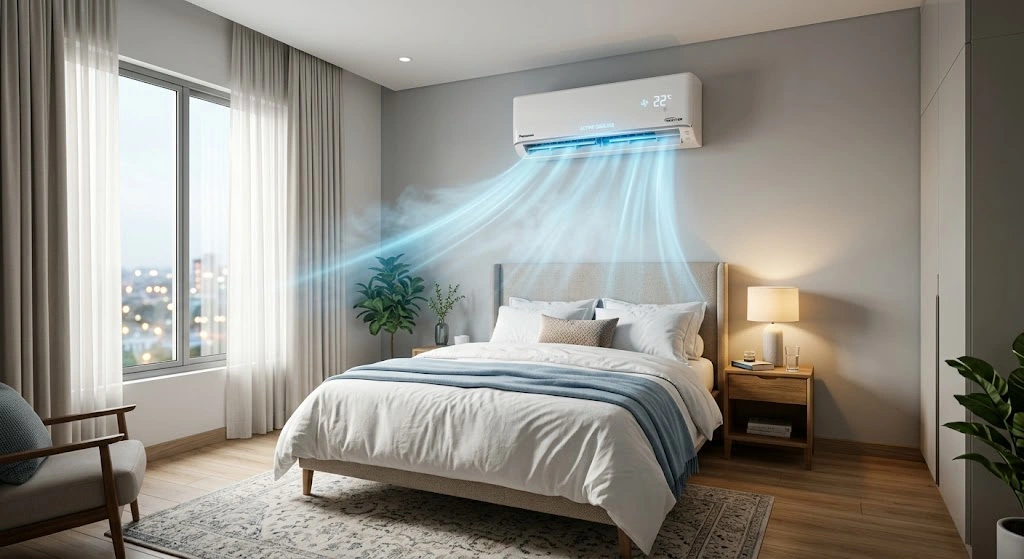
To find the right air conditioner size, multiply your room’s length by its width to get square footage, then apply the rule of 20 BTUs per square foot. A 150 sq ft room needs around 5,000 BTU. Adjust for ceiling height, sunlight, occupants, and local climate for a more precise result.
Picking the right air conditioner can feel overwhelming — but the answer usually comes down to one thing: size. If you’ve been asking yourself what size air conditioner do I need, you’re already asking the right question. Get the size wrong, and you’ll end up sweating through summer or watching your energy bill climb for no good reason.
The good news? Sizing an AC unit is simpler than it sounds once you know what to look at.
What Does “AC Size” Actually Mean?
When HVAC pros talk about air conditioner size, they’re not talking about how big the unit is physically. They mean cooling capacity, measured in BTUs — British Thermal Units per hour.
A BTU tells you how much heat an air conditioner can pull out of the air in one hour. The higher the BTU rating, the more cooling power the unit has. For whole-home systems, you’ll also hear the word tons — one ton of cooling equals 12,000 BTUs per hour.
So a 2-ton central air system has 24,000 BTUs of cooling capacity. A small window unit might be just 5,000 BTUs.
Neither bigger nor smaller is automatically better. The goal is to match the unit’s capacity to your actual space.
Why Getting the Right Size Matters
Most people assume that a bigger air conditioner is always the safer choice. In reality, an oversized unit can cause just as many problems as one that’s too small.
When an AC unit is too powerful for the room, it cools the space too fast and shuts off before it has time to remove the humidity from the air. The result is a room that feels cold and clammy — not comfortable. This on-off cycling also wears out the compressor much faster and drives up your energy bills.
On the flip side, an undersized unit runs constantly trying to hit a temperature it simply can’t reach. It struggles, wastes energy, and still leaves you hot.
The right size cools efficiently, removes moisture steadily, and keeps your home comfortable without working harder than it needs to.
How to Calculate What Size Air Conditioner You Need
Start With Square Footage
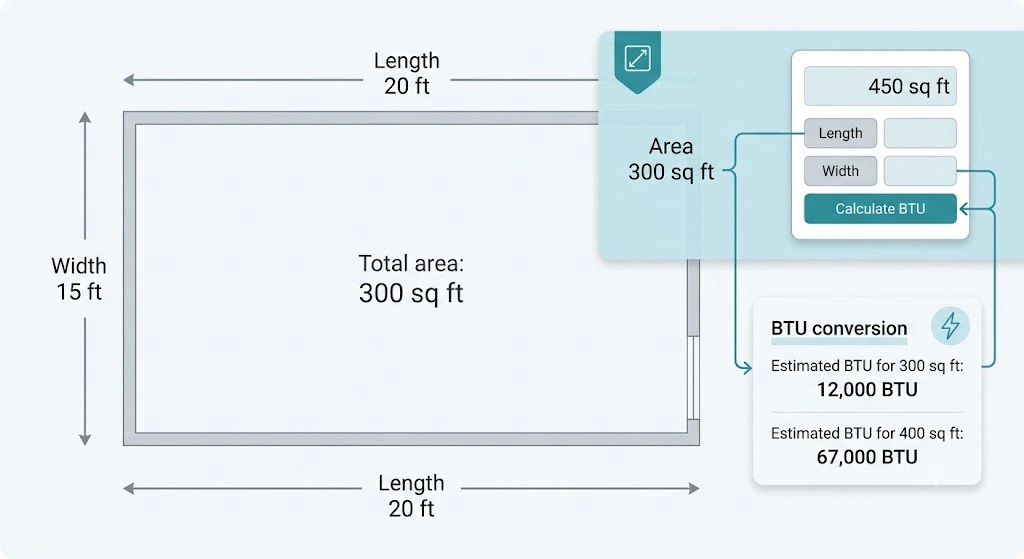
The most important number you need is the size of the space you’re cooling. Measure the length and width of the room, then multiply them together.
A 12-foot by 15-foot bedroom, for example, is 180 square feet. A 20-foot by 25-foot living room is 500 square feet.
Once you have that number, use the U.S. Department of Energy’s baseline rule: 20 BTUs per square foot. That gives you a solid starting point before factoring in anything else.
Room Size to BTU Quick Reference
Here’s a simple way to think about common room sizes:
A small bedroom or home office between 100 and 250 square feet needs roughly 5,000 to 6,500 BTUs. A medium room between 250 and 350 square feet calls for about 7,000 to 8,500 BTUs. A larger living room between 350 and 550 square feet typically needs 9,800 to 12,500 BTUs.
These numbers are your starting point — not your final answer.
Factors That Adjust Your BTU Calculation
Square footage sets the baseline, but several other things can push that number up or down.
Ceiling height is one of the biggest adjusters. Most BTU estimates assume a standard 8-foot ceiling. If your ceilings are taller than that, there’s more air volume to cool. Add about 1,000 BTUs for every foot of ceiling height above 8 feet.
Sun exposure matters more than people realize. A room with large south- or west-facing windows that gets strong afternoon sun absorbs a lot of heat. Bump your BTU estimate up by about 10 percent for a very sunny room. If the room is heavily shaded, you can trim it by 10 percent.
Occupancy plays a role too. People give off body heat. The standard estimate is built for two people in a room. Add about 600 BTUs for each additional person who regularly spends time there.
Kitchen use requires a special adjustment. Stoves, ovens, and appliances generate substantial heat. If you’re cooling a kitchen or an open-plan space that connects directly to one, add 4,000 BTUs to your estimate.
Insulation quality affects how much cooling leaks out. A poorly insulated room with drafty windows will need more cooling capacity than a well-sealed modern space of the same size.
Sizing a Window or Portable AC Unit
Window and portable air conditioners are designed for single rooms or small spaces. They’re sold by BTU rating, and matching that rating to your room size is straightforward using the guide above.
Keep in mind that portable units are generally less efficient than window units of the same BTU rating. They pull in some warm air from inside your home as part of their operation, which reduces their effective cooling power. If efficiency matters to you, a window unit is the better choice for a single room.
For rooms larger than 250 square feet, you may also want to consider a mini-split system instead. These wall-mounted units are quieter, more efficient, and far better at dehumidifying large spaces than a window unit or portable AC.
Sizing a Central Air Conditioner for Your Whole Home
Central air conditioning works differently. Instead of thinking room by room, you’re sizing a system that cools your entire home through a network of ducts.
The general rule of thumb is one ton of cooling for every 500 square feet of living space in a moderate climate. So a 1,500 square foot home would typically need a 3-ton system, or 36,000 BTUs.
But that rule only gets you in the ballpark. Climate zone makes a big difference here. A home in Phoenix, Arizona needs significantly more cooling capacity than the same home in Portland, Oregon. Insulation quality, window count and type, the direction your home faces, and even the color of your roof all shift the math.
For whole-home sizing, the industry standard is something called a Manual J load calculation. This is a detailed analysis that a licensed HVAC contractor performs before recommending a system size. It accounts for dozens of variables — not just square footage — and gives you a genuinely accurate answer.
Most reputable contractors include a Manual J as part of their free installation estimate. If a contractor quotes you a system size based only on square footage and nothing else, that’s a red flag worth paying attention to.
Common AC Sizing Mistakes to Avoid
One of the most common mistakes is trusting the old “bigger is better” logic. Contractors sometimes install oversized units because it avoids callbacks about insufficient cooling — but it creates different problems down the line, including poor humidity control, higher bills, and a shorter equipment lifespan.
Another mistake is ignoring the age and condition of your home’s insulation. An older home with poor insulation needs more BTUs to compensate for the heat that’s constantly seeping in through the walls and attic. Upgrading insulation can actually let you size down to a smaller, less expensive AC system.
Finally, don’t base your sizing decision on what your neighbor has or what the previous unit in your home was. Every home is different, and replacing a unit with the same size as the old one isn’t always the right call — especially if that old unit was never properly sized to begin with.
What Size Air Conditioner Do I Need for Common Home Sizes?
Here’s a general central AC sizing guide for typical home sizes in moderate climates, assuming average insulation and 8-foot ceilings:
A home around 800 square feet generally needs a 1.5-ton (18,000 BTU) system. A 1,200 square foot home typically works well with a 2-ton (24,000 BTU) system. At 1,500 square feet, a 2.5-ton (30,000 BTU) unit is a common fit. For 2,000 square feet, most homes need a 3 to 3.5-ton system. A larger 2,500 square foot home usually calls for a 4-ton (48,000 BTU) unit. And a 3,000 square foot home generally needs a 5-ton (60,000 BTU) system, which is the maximum single-unit size for residential use.
Keep in mind these are estimates. Hot climates, large windows, vaulted ceilings, and poor insulation can all push these numbers higher.
When to Call a Professional
For a single window AC unit in a standard bedroom, doing the math yourself is perfectly reasonable. But for anything larger — a mini-split, a whole-home central system, or a multi-zone setup — it’s well worth having a licensed HVAC contractor run the numbers properly.
A professional Manual J calculation typically costs between $200 and $500 if done independently, but most contractors include it free with their installation quote. That small investment protects you from a decade or more of discomfort and inflated energy bills from a poorly sized system.
Conclusion
Figuring out what size air conditioner you need doesn’t have to be complicated. Start with your room’s square footage, apply the 20 BTU per square foot rule, and then adjust for sunlight, ceiling height, how many people use the space, and your local climate. For a single room, that process takes about five minutes.
For central air, the stakes are higher and the variables more complex. A proper Manual J load calculation from a licensed contractor is the only way to get a truly accurate answer — and most contractors provide it for free.
The right-sized AC keeps you comfortable, controls humidity, and costs less to run over its lifetime. Take the time to size it correctly, and you’ll feel the difference every summer.
