

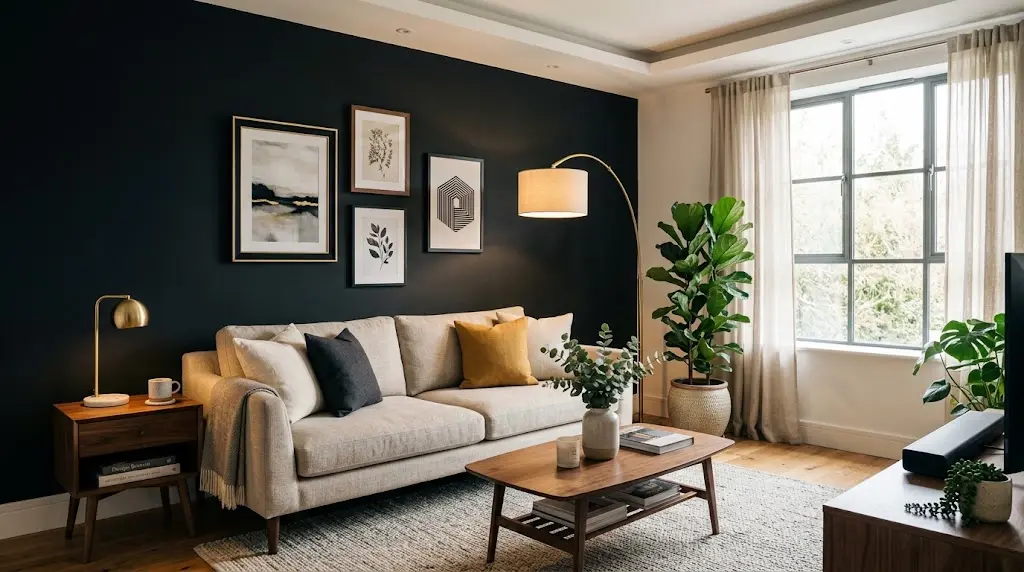
What is a black accent wall? A black accent wall is one wall painted a deep black shade to add contrast and depth to a room. It works best on the wall your eye lands on first, like the one behind a bed, sofa, or fireplace, and pairs beautifully with warm lighting and natural wood.
Black accent walls have a reputation for being risky, but they’re one of the easiest ways to make a plain room feel finished. One wall, one weekend, and suddenly your space has a center of gravity it didn’t have before. Your art looks sharper. Your plants look greener. Your lamps actually glow instead of just sitting there.
The catch is that black shows every decision you make. Pick the wrong wall or the wrong sheen and the room feels heavy instead of cozy. So let’s walk through the whole thing, from choosing the wall to choosing the shade to making it feel warm instead of cave-like.
Why Black Accent Walls Work So Well
Black does something no other color does: it pushes backward. A dark wall reads as farther away than a white one, which means a small room doesn’t automatically shrink. It often feels deeper.
Black also acts like a backdrop. Anything you place in front of it gets an outline. A wood dresser stops blending into the wall behind it. A gallery of frames suddenly looks curated instead of scattered. Designers lean on this constantly, because a dark wall does the styling work for you.
There’s a practical perk, too. A black wall is the best place in your house to hang a TV. The screen’s bezel disappears into the paint, so you stop noticing the black rectangle when it’s off.
And unlike a full dark room, a single wall is low commitment. You’re painting maybe 120 square feet. If you hate it in six months, you’ve lost one gallon and an afternoon.
How to Choose the Right Wall
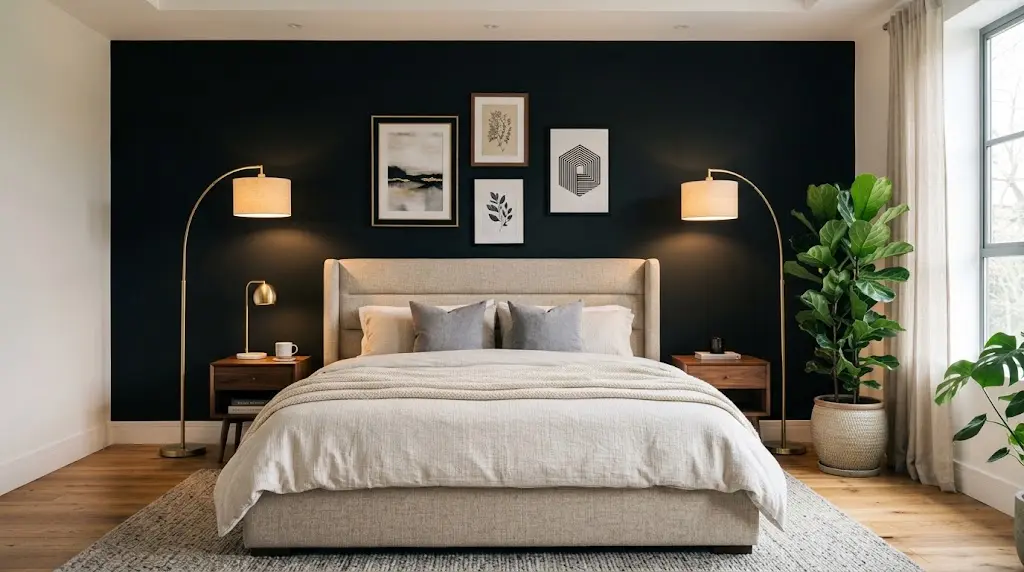
This is where most people go wrong. They paint whichever wall is easiest, and the room feels off afterward.
Walk into the room and notice where your eyes land first. That’s usually your accent wall. In a bedroom, it’s the wall behind the headboard. In a living room, it’s behind the sofa or around the fireplace. In a home office, it’s the wall behind the desk, which also gives you a great video call background.
Skip walls chopped up by windows and doors. All those interruptions break the solid block of color that makes the look work, and cutting in around three window frames in black paint is a miserable job.
Pay attention to light, too. A wall that gets direct sun for part of the day will look dusty and gray in that light, then rich and inky at night. A wall across from a window usually holds its color better because it’s lit indirectly. Neither is wrong, but you should know what you’re signing up for.
One more thing: consider the wall you see from the doorway versus the wall you sit facing. If you spend evenings on the couch staring at a black wall, make sure that’s the mood you want.
Picking the Right Shade of Black
Not all blacks are actually black. Most have undertones that show up once they’re on a big surface, and that surprise is what makes people say “I hate it” after the first coat.
Designers talk about LRV, or light reflectance value, a scale where 0 is pure black and 100 is pure white. The lower the number, the less light bounces back.
Sherwin-Williams Tricorn Black is the go-to when you want black with no personality of its own. It sits at an LRV of about 2.45, making it one of the truest, most neutral blacks available, so it won’t read blue or brown as the light changes through the day.
Benjamin Moore Onyx is a good pick if you want something slightly warmer that still reads as full black. It’s a favorite behind desks and fireplaces because it softens the edge without giving up drama.
Benjamin Moore Wrought Iron is the gentler option. With an LRV around 8, it’s one of the lighter “blacks”, and it carries hints of blue and charcoal. In a bright room it reads black. In a dim room it leans moody navy-gray. That flexibility makes it a smart choice for anyone nervous about going all in.
Sherwin-Williams Iron Ore is technically a very dark gray, not a black. It’s softer and warmer than Tricorn Black, which makes it a nice fit for farmhouse or transitional rooms where a true black would feel too formal.
Whatever you’re drawn to, buy a sample. Paint a two-foot square directly on the wall or on a piece of poster board you can move around. Look at it in the morning, in the afternoon, and under your lamps at night. Blacks shift more than any other color.
Sheen Matters More Than You Think
Sheen is the finish of the paint, and with dark colors it changes everything.
Matte and flat finishes absorb light, so the wall looks velvety and the color stays even. This is what most people picture when they imagine black accent walls. The downside is durability. Flat black scuffs easily and shows fingerprints around light switches, so it’s better in bedrooms than in hallways.
Eggshell and satin bounce a little light back. They’re easier to wipe down, but they also highlight every dent, patch, and roller mark in your drywall. Black paint is brutally honest about imperfections.
That’s why prep matters here more than with a light color. Fill the nail holes, sand them smooth, and run your hand over the wall before you start. Anything you can feel, you’ll see.
Many painters also recommend a gray-tinted primer under black paint. It cuts the number of coats you need, and black almost always needs two coats minimum, sometimes three.
Styling a Black Accent Wall Without Making It Gloomy
The difference between moody and depressing comes down to what you put around the black.
Warmth is the fix. Natural wood is the easiest partner, whether that’s a walnut nightstand, oak floating shelves, or a cane headboard. The grain reads even warmer next to black, and the two balance each other out.
Metals do a lot of work here too. Brass, gold, and aged bronze glow against a dark wall in a way they never do against white. Even swapping a couple of picture frames or a lamp base makes a noticeable difference.
Lighting is where people underinvest. One ceiling fixture is not enough for a room with a dark wall. Add a table lamp, a sconce, or a floor lamp so there are pools of light at different heights. Warm bulbs, around 2700K, keep the black looking rich instead of cold.
Texture keeps things interesting. A chunky knit throw, a jute rug, or a plaster-finish vase gives your eye something to catch. Some people take this further and add board and batten, vertical slats, or shiplap before painting, which turns a flat wall into an architectural feature. The shadows the trim casts do half the decorating.
Plants deserve a mention on their own. Green against black is one of the most reliable color pairings in interior design, and a single large plant in the corner softens the whole wall.
Common Mistakes to Avoid
The biggest one is painting a wall black in a room with almost no natural light and no plan to add lamps. Black absorbs light. If you don’t put light back in, the room will feel closed off.
The second is ignoring the trim. If your baseboards and door casings are bright white, that crisp line can look sharp and graphic, or it can look unfinished, depending on the style of the room. Painting the trim the same black gives you a seamless, modern look. Both work. Just make it a decision instead of an accident.
The third is skipping the sample step because black seems like it can’t go wrong. It absolutely can. A black with blue undertones next to warm beige furniture will fight you every day.
And finally, don’t feel obligated to stop at paint. Black wallpaper, limewash, and peel-and-stick options all give you a similar effect, and renters can use removable versions without risking a deposit.
Bringing It All Together
Black accent walls work because they create contrast, and contrast is what makes a room feel intentional. You’re not just adding a color. You’re giving the space a focal point and letting everything else arrange itself around it.
Start by picking the wall your eye naturally finds. Test two or three shades on that exact wall and live with them for a few days. Prep the surface properly, choose a matte finish if the room is low-traffic, and plan your lighting before you open the can.
Do those four things and you’ll end up with a wall that feels like it was always meant to be there. And if you’re still on the fence, remember that this is paint. It’s the most forgiving decision in your entire house.
