

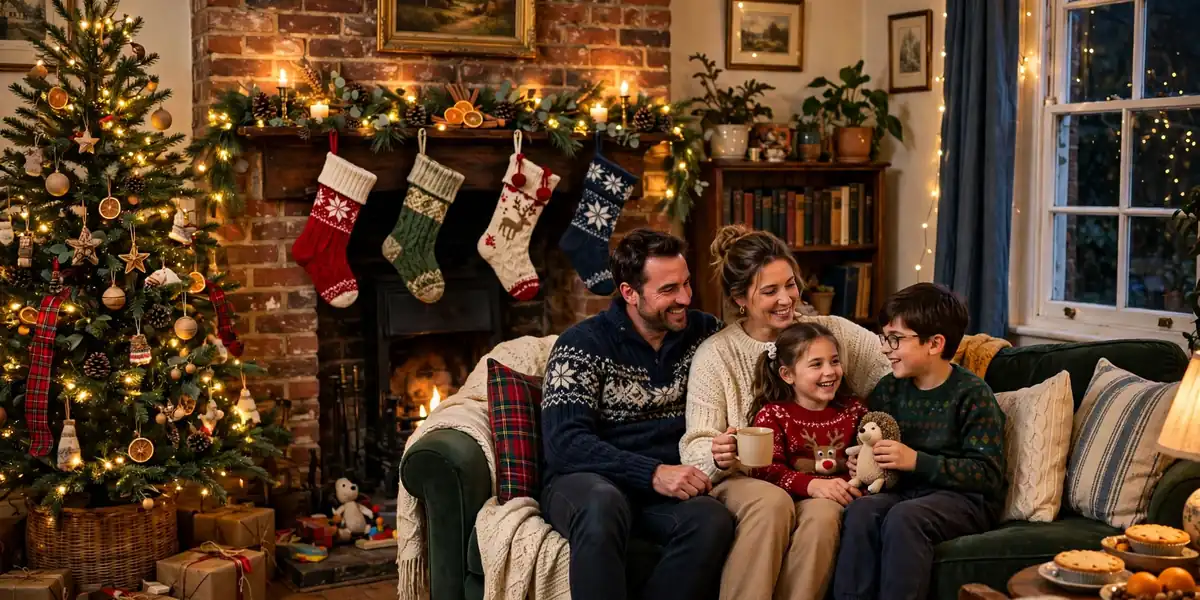
Why a UK Christmas at Home Feels Different
A UK Christmas at home is not one big day. It is a slow season that builds at home, peaks on Christmas Day, softens on Boxing Day, and then fades out in early January.
Much of it happens in small, familiar spaces. A living room that is used every day becomes the room for presents. A kitchen that is used every day becomes the room for the big meal. A hallway fills with coats, boots, cards and bags of presents.
This guide stays in the UK. It follows the days, customs and home habits that shape a British Christmas at home. It does not try to be a guide for another country, and it does not try to be a decorating manual. Its question is simple: what does Christmas at home in the UK actually look like, day by day?
Advent at Home: How the Season Starts in a British House
Advent is the countdown, and in many UK homes it starts quietly. An Advent calendar appears on a kitchen wall or a mantel. A child opens one small door each morning. An adult may do the same, with a calendar that holds chocolate, tea, or a small daily note.
The first Sunday of Advent often marks a change in the house. A wreath may go on the front door. Cards start to arrive and are lined up on a shelf, a mantel, or strung along a hall. The house does not change all at once. It changes a little each day.
Many families also start to plan in Advent, not just to decorate. Who is coming for Christmas Day? Who is staying overnight? What food needs to be ordered early? In a small home, those questions matter more, because space for guests, food and presents is limited.
Advent is also when school and local life feed into home life. A nativity play, a carol service, or a school fair can fill an evening, and children bring home cards, songs and excitement. The home then becomes the place where all of that excitement lands.
Christmas Eve at Home: Stockings, Carols and Last Preparations
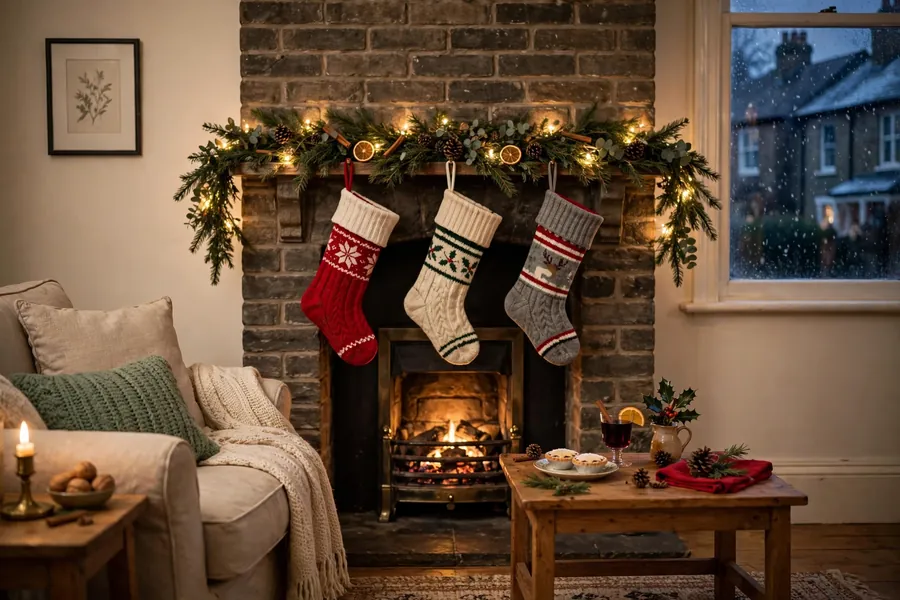
Christmas Eve at home has its own calm rush. Presents are wrapped, often late, and placed ready for the morning. Stockings are hung, often at the end of a bed or by a fireplace where a home has one.
Children in many UK homes leave out a mince pie and a drink for Father Christmas, and a carrot for his reindeer. It is a small, kind ritual, and it gives Christmas Eve a clear end point. Once the stocking is hung and the treat is left out, it is time for bed.
For adults, Christmas Eve is often about food preparation. Potatoes may be peeled. A pudding may be checked. A table may be set for the next day. The work is done in advance so Christmas Day itself can stay relaxed.
Some families watch a carol service on television, sing carols at home, or go out to a local carol service and then come back to a warm house. The pattern varies, but the feeling is common: the waiting is almost over, and the house is ready.
Christmas Morning at Home: Presents, Stockings and a Slow Start
Christmas morning in a UK home usually starts early, and often starts with stockings. A stocking holds small gifts, fruit, and treats, and it is opened before the main presents under the tree.
Main presents follow, often in the living room, with wrapping paper piling up fast. In a smaller room, this can feel joyful and chaotic at once. Many families pause after presents for a late breakfast, with time to enjoy a new book, a game, or a warm drink before the cooking takes over.
The King’s Speech, broadcast on Christmas Day afternoon, is a familiar part of the day for many households. Some families watch it together. Others have it on in the background while they cook or play. It is one of those shared moments that marks the day as Christmas Day, not just any family Sunday.
Christmas morning is not a tidy event. It is loud, warm, and a little messy, and that mess is part of the tradition.
Crackers at the Table: Paper Crowns, Jokes and Small Gifts
No UK Christmas meal at home feels quite complete without crackers. A cracker is a coloured paper tube that two people pull until it snaps with a loud bang.
Inside, there is usually a paper crown, a small joke, and a small gift. Everyone at the table wears a crown for the meal, even adults who would never wear one at any other time of year. The jokes are famously weak, and that is the point. They make the table laugh without effort.
Crackers are said to have started in London in the Victorian era, when a sweet maker added a snap to a wrapped sweet. Over time, the sweet gave way to the crown, the joke and the gift we know today.
Pulling crackers is not a side detail. It is the moment when a formal meal turns into a family meal, with everyone taking part in the same small ritual.
The Christmas Meal at Home: Turkey, Pudding and Leftovers
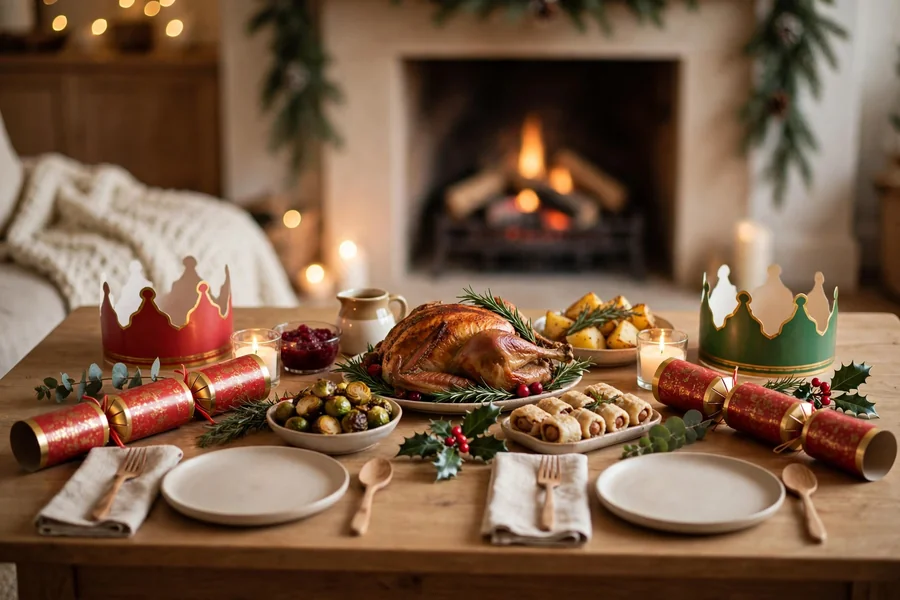
The Christmas meal at home is the centre of the day for many UK families. Roast turkey is the most familiar main dish, served with roast potatoes, vegetables, stuffing and cranberry sauce. Some families choose a different roast, but the shape of the meal stays similar: a large shared plate, a full table, and plenty of food.
For dessert, Christmas pudding is the classic choice, often served with brandy butter or cream. Mince pies appear through the season and again at the meal, with tea or coffee after.
The meal is rarely rushed. It is followed by time on the sofa, a board game, a walk, or a quiet chat. Leftovers then become part of the next days, with cold turkey, bubble and squeak, and sandwiches made from what is left. That second life for the food is itself a UK home tradition, shaped by a full fridge and a house full of people.
Cooking for a large meal in a small kitchen takes planning. Hobs fill up, oven space runs out, and timing matters. Many families cook in stages, keep some dishes warm, and accept that not everything will arrive at the table at the same moment. That is normal, and it does not spoil the meal.
Boxing Day at Home: Walks, Football and a Quieter House
Boxing Day, on 26 December, is a public holiday in the UK and a day with its own home rhythm. It is named for the tradition of giving boxes or gifts to people who had served a household through the year, such as servants and tradespeople, who could then take the day to spend with their own families.
Today, Boxing Day at home is often quieter than Christmas Day. Many families go for a walk, often in cold, bright air, to stretch legs after a large meal. Others watch football on television, play board games, or visit family they did not see on Christmas Day.
Food on Boxing Day is usually simpler. Cold meats, leftovers, pickles and bread make an easy meal, with no need for another large roast. Shops may hold sales, but the home part of Boxing Day is about rest, fresh air and unhurried time.
For families with guests staying over, Boxing Day is also a practical day. Beds are made, bags are packed, and the house slowly returns to normal, one room at a time.
How Period Homes, Townhouses and Smaller Rooms Shape Christmas
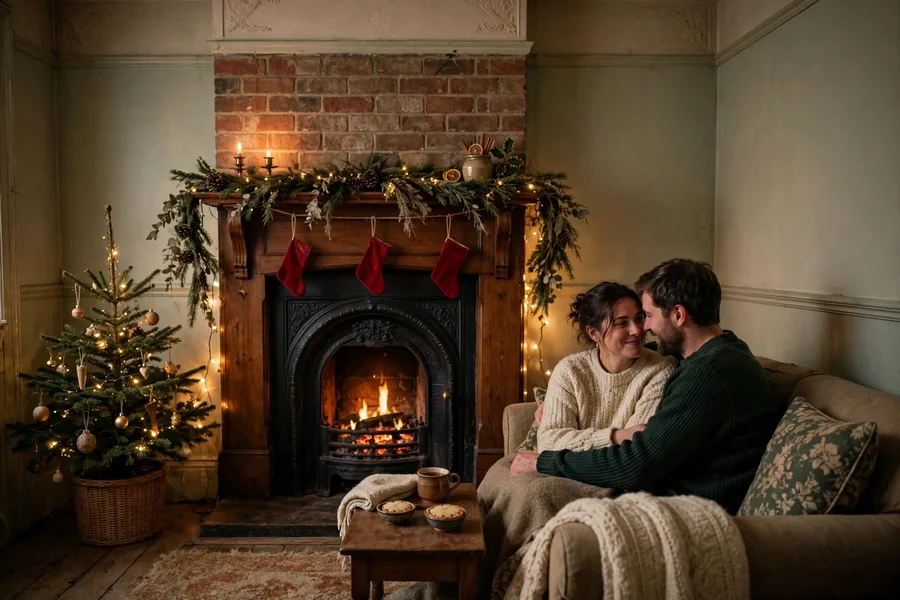
UK homes shape Christmas in ways that are easy to miss. A period home may have a fireplace that becomes the natural focus of the living room. A townhouse may have rooms stacked over several floors, so people move up and down stairs between cooking, eating and relaxing.
A smaller living room changes how a family gathers. There may be room for a tree, but not for a large display around it. Presents may be stacked in a corner. Guests may sit close together, and that closeness becomes part of the day.
A smaller kitchen changes how the meal is cooked. Worktops fill fast, so preparation starts early and dishes are kept simple where possible. A dining room, where a home has one, may be used only for the Christmas meal, while the rest of the year it serves another purpose.
Hallways matter too. In winter, a hallway holds coats, scarves, boots and umbrellas for a house full of guests. A front door that opens often, with cold air coming in, is part of the season.
These limits are not problems to fix. They are the reason a UK Christmas at home feels cosy rather than grand. The house sets the scale, and the traditions fit inside it.
Carols, Jumpers and Games: The Small Customs That Fill the Days
Between the big days, small customs fill a UK Christmas at home. Carol singing, at home, at church, or in the street, brings familiar songs into the season. A printed carol sheet, a warm drink, and a group of voices can turn a cold evening into a festive one.
Christmas jumpers, worn at home, at work, at school and at parties, are a newer custom. A bright, bold jumper worn on Christmas Day, or on a jumper day in December, adds humour to a family gathering.
Board games after the meal are another classic. A game that everyone can join, young and old, keeps people at the table after the food is cleared. It also gives a house full of guests something shared to do, without needing to leave the warm room.
Listening for the Christmas number one, the song at the top of the UK singles chart at Christmas, is a lighter tradition for many music fans. It has been a talking point for decades, and it shows how Christmas at home in the UK is shaped by shared culture, not just by what happens inside one house.
Twelfth Night: When Christmas at Home Comes to an End
Twelfth Night marks the end of the festive season for many UK homes. It is often placed on 5 or 6 January, twelve days after Christmas Day, and it is the traditional point when decorations come down.
Many people believe it brings bad luck to leave decorations up beyond Twelfth Night. Whether a family holds that belief or not, Twelfth Night gives a clear, shared date to end the season. Without it, decorations could linger into late January.
Takedown at home is usually practical. Cards are recycled or kept. Fragile ornaments are packed apart from heavier pieces. Boxes are labelled by room, so next December starts more easily. The house then feels lighter, cleaner and ready for the new year.
Some homes take decorations down a little earlier or a little later, and that is fine. The point of Twelfth Night is not a strict rule. It is a gentle close to a season that began in Advent, a way to say Christmas at home is over, for this year.
Staying Safe at Home Through the UK Festive Season
A warm UK Christmas at home also needs a few safety habits, especially with fairy lights, candles and cooking in a busy house.
Warwickshire Fire and Rescue Service gives clear festive advice for UK homes, including checking fairy lights for British Standard BS EN 60598, turning fairy lights off when leaving the house or going to bed, keeping candles on a heatproof surface away from decorations and fabrics, and never leaving candles burning unattended. Read its guide here: Warwickshire festive fire safety tips
Smoke alarms on every level of the home should be working, and their batteries should never be borrowed for presents. Cooking should never be left unattended, and sockets should not be overloaded with lights, chargers and heaters at once.
These checks do not spoil Christmas. They let a house full of people relax, knowing the warm, busy home is also a safe one.
Your UK Christmas at Home Plan: Advent to Twelfth Night
Start in Advent by planning who is coming, who is staying, and what food needs ordering early. Keep the house calm by adding cards, a wreath and a calendar a little at a time, not all at once.
On Christmas Eve, hang stockings, leave out a mince pie and a carrot, and prepare food for the next day. On Christmas Day, enjoy stockings and presents in the morning, pull crackers at the table, and share a large meal without rushing it.
On Boxing Day, walk, rest, play games, and eat simply from leftovers. In early January, take decorations down by Twelfth Night, pack them well, and let the house return to normal.
That order, from Advent to Twelfth Night, is the shape of a UK Christmas at home. It is not about a perfect house. It is about a house that is lived in, shared, and warm, through the coldest, darkest days of the year.
The UK Christmas at Home Verdict: Slow Days, Warm Rooms, People First
A UK Christmas at home does not need a grand display or a perfect timetable. It needs slow days, warm rooms, and people together, from the first Advent calendar door to the last decoration packed away at Twelfth Night.
Crackers at the table, stockings in the morning, a shared meal, a Boxing Day walk, and a quiet house in early January are the customs that make the season feel British and homely. Keep those customs at the centre, let your period home or townhouse set the scale, and the rest will follow.
If you are planning Christmas at home in the UK in 2026, start with Advent, not with a shop. Plan the people first, the food second, and the house will do the rest.
Frequently asked questions
When does a UK Christmas at home start?
For many homes, it starts in Advent, with a calendar, cards, and early planning for guests and food, building a little each day toward Christmas Eve.
What is Boxing Day?
Boxing Day is 26 December, a UK public holiday linked to giving boxes or gifts to people who served a household, and today it is often a quieter day for walks, football, games and leftovers.
When should decorations come down in the UK?
Many homes aim for Twelfth Night, often 5 or 6 January, when decorations are taken down and packed away for the next year.
What is inside a Christmas cracker?
A cracker usually holds a paper crown, a small joke, and a small gift, and it snaps with a loud bang when two people pull it at the table.
