

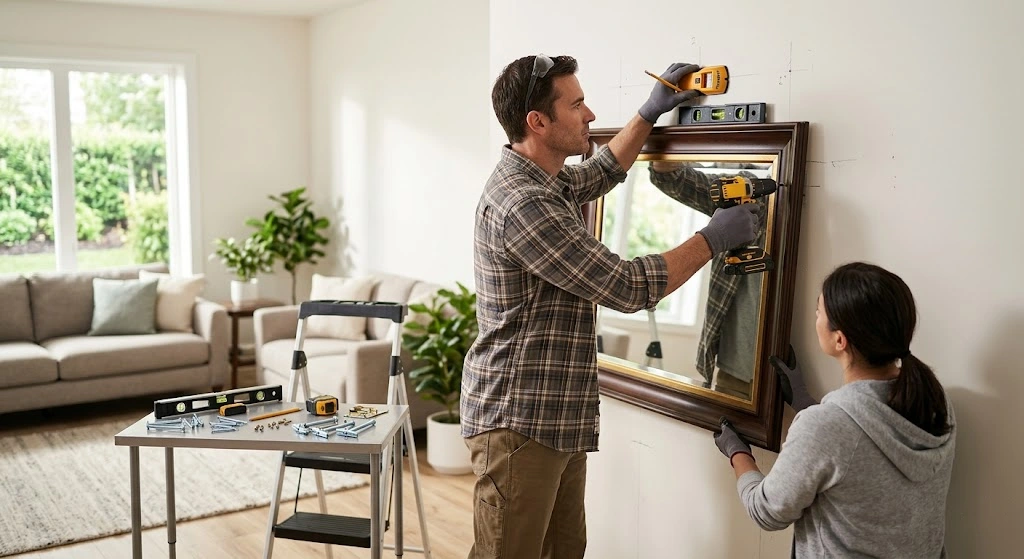
How To Hang a Heavy Mirror To hang a heavy mirror safely, weigh it first, then locate wall studs with a stud finder. Use hardware rated above the mirror’s weight — toggle bolts, snap anchors, or a French cleat for mirrors over 50 lbs. Mark, level, drill, and always use a helper for the final lift.
Hanging a heavy mirror feels intimidating — but it does not have to be. With the right hardware and a clear plan, you can hang a heavy mirror safely on almost any wall without cracking the drywall, damaging the frame, or risking a fall. The key is matching your hardware to both the mirror’s weight and your wall type before you ever pick up a drill.
This guide walks you through every step, from weighing your mirror and finding studs to choosing the right anchors and getting it perfectly level.
Know Your Mirror’s Weight Before You Buy Any Hardware
The single biggest mistake people make is grabbing whatever hooks are on the shelf without checking the weight rating. A standard picture hook holds around 20 pounds. A large framed mirror can easily weigh 50 to 80 pounds — and some antique or oversized mirrors push past 100.
Weighing your mirror takes less than two minutes. Step on a bathroom scale and note your weight. Then pick up the mirror and step on again. The difference is your mirror’s weight. That number drives every hardware decision that follows.
Once you have the weight, use this as your general guide for drywall installations:
Under 20 lbs calls for two standard picture hooks. Between 20 and 40 lbs, use two self-drilling zinc anchors or screws driven directly into a wall stud. Between 40 and 75 lbs, toggle bolts or snap toggles at two points work well. Anything between 75 and 150 lbs really deserves a French cleat spanning at least two studs. Over 150 lbs, use a metal French cleat system or call a professional.
Always choose hardware rated well above your mirror’s actual weight. If the mirror weighs 60 pounds, use anchors rated for 80 or more. That buffer accounts for daily vibrations, shifting, and the long-term stress a heavy object puts on a wall.
Understand Your Wall Type First
Not every wall handles weight the same way. Drywall is by far the most common material in modern homes, and it is also the most forgiving when you use the right anchors. But it cannot support heavy loads on its own — the strength comes from the wood studs behind it.
Plaster walls, common in older homes, are denser but more brittle. Drill slowly with a masonry bit to avoid cracking, and switch to a standard bit once you get past the plaster layer.
Concrete or brick walls require masonry anchors and a hammer drill. They are actually excellent for heavy mirrors because the material itself is so strong.
Tile walls in bathrooms need a tile drill bit and extra patience. Drill at low speed with light pressure to avoid cracking the tile surface.
Knowing your wall type prevents you from buying the wrong anchors — and from drilling a messy hole that will not hold.
Tools You Will Need
Gathering everything before you start saves a frustrating mid-project hardware run. You need a stud finder, a tape measure, a pencil, a drill with appropriate bits, a level (a 24-inch bubble level works great), and a screwdriver. Have your chosen wall hardware ready, and keep a helper on standby for the lifting step.
If your mirror does not already have hanging hardware on the back, add D-rings, a hanging wire, or a French cleat before you do anything else on the wall side.
How To Hang a Heavy Mirror: Step-by-Step
Step 1: Locate the Wall Studs
Use a stud finder and run it slowly across the wall. Mark each stud location lightly in pencil. In most homes, studs are spaced 16 inches apart. Screws driven directly into studs hold dramatically more weight than any anchor in drywall alone, so hitting at least one stud — ideally two — is always the goal.
If your mirror is wide enough to span two studs, that is ideal. If not, you will need high-quality drywall anchors to make up for the single attachment point.
Step 2: Mark the Hanging Height
Decide where the top of the mirror should sit. A common rule of thumb is to center the mirror at eye level, roughly 57 to 60 inches from the floor to the mirror’s center. For bathroom mirrors above a vanity, the bottom edge typically sits four to six inches above the countertop.
Hold the mirror against the wall (or have your helper hold it) and mark a line at the top edge with a pencil. This reference point is what you will measure down from when placing your hardware.
Step 3: Find the Hook or Anchor Placement
The hook or anchor on the wall does not go at the top of the mirror — it goes where the mirror’s hanging hardware actually contacts the wall. For a mirror with a hanging wire, have your helper hold the mirror by the wire while you measure the distance from the wire’s highest point down to the top edge of the frame. Transfer that measurement below your top-of-mirror pencil line. That is where your hooks go.
For D-rings, use a long piece of tape pressed across the back of the mirror at the ring locations to capture their exact spacing. Transfer that measurement to the wall, checking that both marks are level.
Step 4: Install the Wall Hardware
If you are screwing into a stud, drill a pilot hole slightly smaller than your screw diameter, then drive the screw until it is snug. Do not over-tighten — you want the hook to be secure but not stripped.
For drywall anchors, drill the hole size specified on the anchor’s packaging. Insert the anchor flush with the wall surface. Toggle bolts require a slightly different approach: fold the toggle wings flat, push the bolt through the wall, and let the wings spring open on the other side. Pull back gently and tighten until the toggle contacts the back of the drywall.
Check that all anchor points are level before moving on. An eighth-of-an-inch difference here shows clearly once the mirror is up.
Step 5: Hang the Mirror With a Helper
Never lift a heavy mirror alone. Glass is awkward, heavy, and unforgiving if it slips. A helper makes the lift safer and makes lining up the hardware far easier.
Grip the mirror from the sides or bottom, not by the frame edge. Lift together, align the hanging hardware with your wall hooks, and lower it slowly into place. Do not force it — if something feels off, set the mirror down and recheck your measurements.
Once it is on the wall, press gently at several points around the frame to confirm it feels solid and does not wobble.
Step 6: Check for Level and Stability
Step back and look at the mirror from a few feet away. Even a slight tilt is obvious once you have some distance. Use your level across the top edge of the frame to confirm it is straight.
If it needs adjusting, most wire-hung mirrors can be nudged left or right by shifting the wire on the hook. For D-ring hangers, you may need to move one hook slightly.
Once it is level, apply gentle pressure at the top, sides, and bottom. Nothing should shift. If there is movement, tighten the fasteners or add a second anchor point for support.
Why a French Cleat Is the Best Option for Very Heavy Mirrors
For mirrors over 50 to 75 pounds, a French cleat is worth every extra minute it takes to install. It is two interlocking strips — one attached to the wall, one to the back of the mirror — each cut at a 45-degree angle. When the mirror is lowered onto the wall strip, gravity pulls the two angled surfaces together into a self-locking connection.
The real advantage is load distribution. Traditional hooks or D-rings concentrate all the weight on a few small points. A French cleat spreads that weight across the entire length of the strip, which can span two or three wall studs. A 36-inch wooden cleat screwed into two studs can support well over 200 pounds.
Aluminum French cleat kits are available at most home improvement stores for $15 to $25 and include both strips, screws, and anchors. They are thinner than wooden cleats and keep the mirror sitting nearly flush against the wall, which looks much cleaner.
The wall-side strip goes up with the angled face pointing outward and upward. The mirror-side strip attaches near the top of the mirror’s back with the angle facing inward and downward. When you hang the mirror, the two pieces interlock and the mirror cannot lift off the wall on its own.
Common Mistakes To Avoid
Using plastic expansion anchors for anything over 20 pounds is one of the most common errors. These anchors are fine for lightweight shelves and small frames, but they crush and pull loose over time under sustained heavy loads. Stick to toggle bolts, snap anchors, or studs for anything substantial.
Skipping the weight check is another frequent problem. Many people grab a mirror from a store, assume it is manageable, and use whatever hooks they have. The mirror looks fine for a month — then falls at 3 a.m. Always weigh it first.
Hanging the mirror at the wrong height wastes a lot of effort. Think about who uses the room and at what height the mirror is most functional. In a living room above a fireplace, center it visually with the mantel. In a hallway, aim for the center of the mirror to sit at average eye level.
Rushing the leveling step is the last common mistake. It takes an extra 90 seconds to confirm the mirror is straight. Skipping it means every glance in the mirror for years will feel slightly off.
A Note on Frameless and Oversized Mirrors
Frameless mirrors need a different approach because there is no frame to attach hardware to. J-channel brackets work well here — they support the bottom edge of the mirror while top clips hold the upper edge against the wall. Always use pads between the clips and the glass to protect the edges from chipping.
For very large mirrors — anything over 48 by 60 inches — plan on having two helpers for the lift. One person holds each side while a third guides the mirror onto the mounting hardware. Rushing this step with too few hands is how most installation accidents happen.
Conclusion
Hanging a heavy mirror safely comes down to three things: knowing how much it weighs, choosing hardware that is rated well above that weight, and taking the time to find your studs and get everything level. The process is straightforward once you have the right tools and a helper for the final lift.
A French cleat is the gold standard for anything over 50 pounds — it distributes weight beautifully and keeps the mirror flush and solid against the wall. For lighter mirrors, a pair of toggle bolts or stud-mounted screws does the job just as well.
Take it step by step, double-check your measurements, and do not rush the leveling. A mirror that is hung properly on the right hardware will stay put safely for years to come.
