

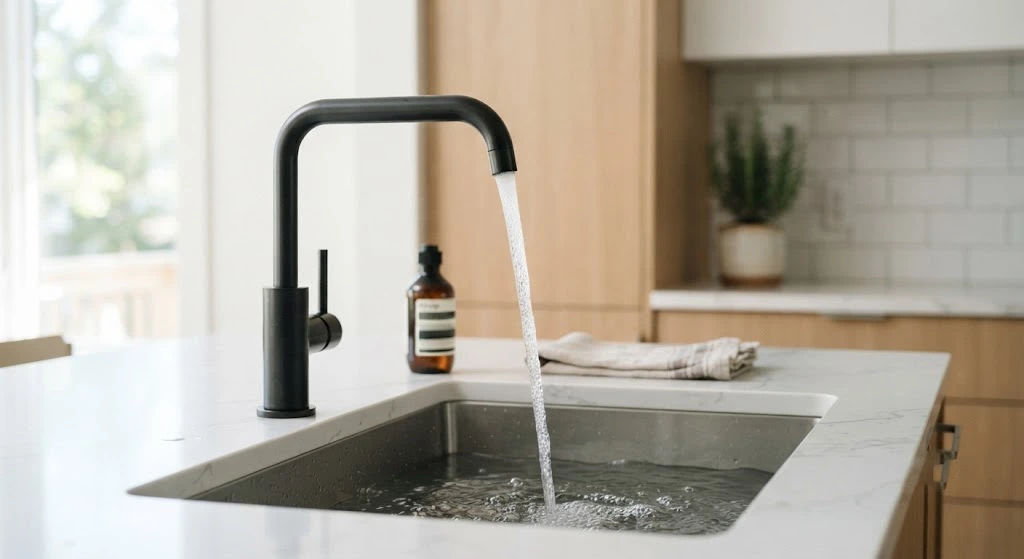
Nothing derails your morning faster than a shower that barely trickles or a kitchen faucet that takes forever to fill a pot. If you’re on a municipal water system and dealing with weak flow, the good news is that most causes are easy to diagnose and many are just as easy to fix.
This guide breaks down exactly why city water pressure drops, how to test it yourself, and which fixes to try first — from a five-minute aerator cleaning to installing a booster pump. Whether your problem is house-wide or limited to one stubborn faucet, you’ll know how to track it down and solve it.
How Water Pressure Reaches Your Home
City water doesn’t just flow to your house by gravity alone. Municipal systems use a combination of pumps and elevated water towers to push water through underground mains and into individual homes. How much pressure actually reaches your tap depends on a few factors: your elevation relative to the water source, the distance from the main line, and how much demand your neighborhood is placing on the system at any given moment.
Once water reaches your property, it enters through a main supply line — usually near the water meter — and then branches out through the pipes running to every fixture in your home.
What counts as “normal” pressure? Most plumbing codes and manufacturers consider anywhere from 30 to 80 pounds per square inch (psi) to be an acceptable range. But acceptable isn’t the same as ideal. Licensed plumbers generally agree that homes perform best around 50 psi — strong enough for a satisfying shower and quick-filling appliances, but not so high that it stresses pipe joints, valves, and water-using appliances over time.
Keep in mind that pressure naturally rises and falls throughout the day as your neighbors run dishwashers, water lawns, or shower before work. A temporary dip during peak hours is normal. Pressure that stays low no matter the time of day usually points to a specific, fixable problem.
Whole-House vs. Single-Fixture Problems: Start Here
Before you troubleshoot anything, ask one simple question: Is the weak flow happening at every faucet, or just one?
This single distinction narrows down your search dramatically:
- Whole-house low pressure almost always traces back to something upstream — the main shutoff valve, a pressure-reducing valve, or an issue with the municipal supply itself.
- Single-fixture low pressure is usually local — a clogged aerator, a kinked supply line, or mineral buildup inside that one faucet or showerhead.
Common Causes of Low Water Pressure
Low pressure typically comes from one of two places: a blockage restricting flow at a specific fixture, or a system-wide issue affecting your entire home. Here are the usual suspects:
- Clogged pipes or fixtures — mineral scale and sediment build up inside aerators, showerheads, and pipe walls over time, narrowing the space water can flow through.
- Hidden leaks — even a small, slow leak can rob pressure from the rest of your system while quietly driving up your water bill.
- Municipal supply issues — construction, water main repairs, or high demand in your area can temporarily reduce the pressure the city delivers to your home.
- A partially closed main shutoff valve — this often happens after plumbing repairs, renovations, or a water heater replacement, when the valve isn’t reopened all the way.
- A malfunctioning pressure-reducing valve (PRV) — if this valve is set too low or has started to fail, it can starve your whole house of pressure.
How to Test Your Home’s Water Pressure
You don’t need to guess. A water pressure gauge costs very little at any hardware store and gives you a real number to work with.
- Find an outdoor spigot or hose bib, ideally the one closest to where your main line enters the house.
- Turn off every faucet, appliance, and irrigation system inside and outside so nothing else is drawing water.
- Screw the gauge onto the spigot and open the valve all the way.
- Read the psi displayed on the gauge.
A healthy reading typically falls between 40 and 60 psi. If that number comes back low, your problem is likely affecting the whole house — think main valve, PRV, or municipal supply. If the reading looks normal but one faucet still trickles, you’re dealing with a localized clog.
Tip: Test at a few different times of day. If pressure is fine at night but weak during your neighborhood’s peak usage hours, the cause may simply be high demand on the municipal system rather than anything wrong with your own plumbing.
Quick Fixes to Try First
Before scheduling a plumber, these simple steps solve a surprising number of low-pressure complaints.
Clean or Replace Clogged Fixtures
Mineral deposits — especially in areas with hard water — are one of the most common culprits behind weak flow at individual faucets and showerheads.
- Soak faucet aerators and showerheads. Unscrew them and let them sit in white vinegar overnight to break down mineral scale, then rinse and scrub with an old toothbrush before reattaching.
- Check for deeper pipe blockages. If cleaning the fixture itself doesn’t help, the clog may be further back in the line. This is a good point to bring in a professional with a pipe camera or hydro-jetting equipment.
- Flush your water heater. Sediment collects at the bottom of the tank over time, which can restrict hot-water pressure specifically. Check your owner’s manual for the correct flushing procedure, and plan to do this about once a year.
Older homes with galvanized steel piping are especially prone to this kind of internal buildup, since rust and mineral flakes accumulate inside the pipe walls over decades. If you’re cleaning aerators every few months just to keep flow normal, it may be a sign of broader corrosion elsewhere in the system.
Make Sure the Main Shutoff Valve Is Fully Open
It’s easy to overlook, but a main valve that isn’t fully open is one of the most common — and easiest to fix — causes of house-wide low pressure.
- Locate the main shutoff valve, typically near the water meter or where the supply line enters your basement, crawlspace, or utility closet.
- Check the valve type:
- Gate valves should be turned counterclockwise until they stop moving.
- Ball valves are fully open when the handle sits parallel to the pipe.
- If you find it partially closed, open it completely and retest your pressure. This alone often resolves the issue immediately.
Advanced Fixes for Persistent Low Pressure
If the quick fixes don’t move the needle, it’s time to look at your pressure-reducing valve or consider a booster pump.
Adjust or Replace the Pressure-Reducing Valve (PRV)
Most homes on municipal water have a PRV installed to protect pipes and appliances from excessive incoming pressure. It steps down high city pressure to a safer, steadier level — often around 50 psi. When a PRV is set too low, wears out, or fails, it can leave your whole house running weak.
- Locate the PRV, typically installed near the main shutoff valve, often shaped like a bell with an adjustment screw on top.
- To raise pressure, turn the adjustment screw clockwise in small increments.
- Retest with your gauge after each adjustment — don’t make several turns at once.
- If turning the screw has no effect, or the valve looks corroded or damaged, it likely needs replacing rather than adjusting.
Go slowly here. Cranking the PRV up too far can push pressure past safe limits, straining pipe joints and fixtures and potentially causing leaks or premature appliance failure.
Install a Water Pressure Booster Pump
When low pressure comes from something outside your control — long distance from the main, elevation above the municipal supply, or a city system that simply doesn’t deliver strong pressure to your area — a booster pump is often the most reliable long-term fix.
A booster pump is installed near where the main line enters your home, often paired with a small pressure tank to keep flow steady rather than pulsing. Because the installation involves both plumbing and electrical connections, and the pump needs to be sized correctly for your home’s fixture count and usage, this is a job best left to a licensed plumber.
Booster pumps are excellent for pressure problems rooted in your location, but they won’t fix issues caused by clogged fixtures, a closed valve, or a failing PRV — so it’s worth ruling those out first. Costs and installation requirements vary depending on your home’s layout and the size of the pump needed, so get a quote before committing.
When to Call a Plumber
Some symptoms are worth a professional opinion right away, rather than more DIY troubleshooting:
- Discolored water or a strange odor coming from your taps
- Low pressure that doesn’t improve after trying the fixes above
- A sudden, unexplained pressure drop
- Water bills climbing without any change in your usage
- Visible water stains or damp spots on walls, ceilings, or floors
These signs can point to hidden leaks, a failing PRV, corrosion inside your main line, or other issues that aren’t safe or practical to diagnose yourself. A licensed plumber can pinpoint the exact cause and recommend a fix that actually solves the problem instead of masking it.
Keeping Water Pressure Steady Long-Term
Once your pressure is back where it should be, a little routine maintenance goes a long way toward keeping it there:
- Inspect exposed pipes periodically for corrosion, moisture, or small leaks
- Clean faucet aerators and showerheads every few months, especially if you have hard water
- Flush your water heater once a year
- Schedule a plumbing inspection every few years if your home has older piping
- Fix small leaks and drips as soon as you notice them, before they grow into bigger problems
Consider installing a permanent pressure gauge on your main line so you can check readings in seconds. Jotting down occasional numbers — especially after plumbing work, a hard freeze, or seasonal changes — makes it much easier to spot a slow decline before it turns into a full-blown pressure problem.
Final Thoughts
Low water pressure is annoying, but it’s rarely a mystery once you know where to look. Start by figuring out whether the problem is whole-house or isolated to one fixture, test your pressure with a simple gauge, and work through the fixes in order — from cleaning an aerator to adjusting your PRV to, if needed, installing a booster pump. Most homeowners can resolve the issue themselves in under an hour. For anything involving hidden leaks, main line damage, or persistent pressure loss, a licensed plumber can save you time, money, and a lot of frustration.
