

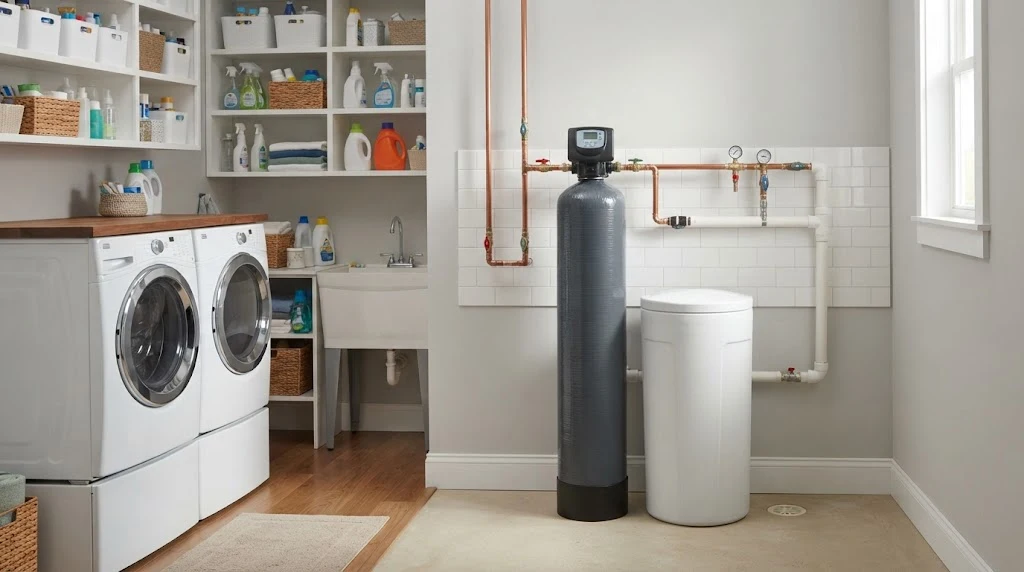
Water softener systems typically cost between $200 and $6,000, depending on the type of system, your home’s water hardness, and the brand you choose. If you’re dealing with cloudy dishes, clogged pipes, dry skin after showering, or a filmy residue on your faucets, a water softener could solve the problem — but picking the right one means understanding what drives the price up or down.
This guide breaks down every cost factor, compares system types side by side, and shares practical tips to help you save money without sacrificing water quality.
Key Takeaways
- Water softeners cost $200 to $6,000, with most homeowners paying around $3,100 on average.
- Ion exchange systems are the most popular mid-range option, running $500–$1,700 for single-tank units and $1,000–$5,000 for dual-tank models that supply continuous soft water.
- The right system size depends on your household size and water hardness level — most homes need a unit with 24,000 to 64,000 grains of capacity.
- Installation typically adds $150–$1,000, with most homeowners paying $500–$700 for standard setups.
How Much Does a Water Softener Cost?
Based on current market research, the average water softener installation costs about $3,100, though your final price will depend heavily on system capacity, type, and features. Here’s a quick breakdown of typical price ranges by system type:
| Water Softener Type | Cost Range |
|---|---|
| Magnetic systems | $200–$600 |
| Single-tank ion exchange systems | $500–$1,700 |
| Dual-tank ion exchange systems | $1,000–$5,000 |
| Salt-free systems | $800–$4,000 |
| Water distiller systems | $1,200–$4,000 |
| Reverse osmosis systems | $1,500–$11,000 |
Prices vary by region and home size. Always request a few quotes before committing to a system.
Pro Tip: Look for a water softener with a built-in water meter instead of a basic timer. Timer-based systems regenerate on a fixed schedule whether they need to or not, wasting salt and water. Metered systems only regenerate based on actual usage — saving you money over the system’s lifetime.
What Affects the Cost of a Water Softener?
Several variables influence your final price tag. Understanding them upfront helps you avoid overpaying — or underbuying a system that can’t keep up with your household’s needs.
1. Water Hardness Level
The harder your water, the more powerful (and often pricier) your system needs to be. Water hardness is measured in grains per gallon (GPG), parts per million (PPM), or milligrams per liter (mg/L). GPG typically falls between 0 and 20, with anything above 7 GPG considered “hard.” One GPG equals roughly 17.1 PPM or mg/L.
If you don’t already know your water’s hardness, many local water treatment companies offer free testing. This is the first step toward choosing a system that actually solves your problem instead of guessing.
Pro Tip: Hard water often leaves visible clues — greenish rings around toilets, chalky residue on faucets, or scale buildup inside your water heater. These stains typically come from high concentrations of calcium and magnesium and can be tough to remove with standard cleaning products.
2. System Size (Grain Capacity)
Your softener’s size is measured in grain capacity — the amount of hardness minerals it can remove before it needs to regenerate. The right capacity depends on two things: how many people live in your home, and how hard your water is.
Here’s a simple way to estimate the size you need:
- Test your water hardness (GPG). A test kit costs around $10, or you can request a free test from a local water company.
- Multiply the number of people in your household by 90 (the average daily gallons used per person). Check your water bill for a more precise number if available.
- Multiply that number by your GPG score.
- Multiply the result by 7 to get your recommended weekly grain capacity.
For example, a family of four using 400 gallons a day with a hardness score of 10 GPG would need a system with roughly 28,000 grains of capacity.
General capacity guidelines:
- 24,000–32,000 grains: Households of 2–4 people with moderately hard water
- 32,000–48,000 grains: Households of 4–6 people or areas with higher hardness
- 48,000–64,000 grains: Larger families in areas with very hard water
- 64,000+ grains: Homes with up to 8 people, multiple bathrooms, high water use, or commercial applications
| Water Hardness (GPG) | Recommended Capacity | Estimated Cost |
|---|---|---|
| 6–9 | 24,000 grains | $300–$600 |
| 10–12 | 32,000 grains | $400–$1,000 |
| 13–18 | 48,000 grains | $500–$1,200 |
| 18–20 | 64,000 grains | $1,000–$1,500 |
| 20+ | 80,000+ grains | $1,200–$1,800 |
Bigger systems cost more upfront, but they regenerate less often — using less salt and water over time, and providing consistent soft water even during high-demand periods like morning showers. If you’re between two sizes, it’s usually smarter to go larger rather than smaller.
Did You Know? An undersized system will run constantly, wear out faster, and may leave you with hard water during peak usage. An oversized system wastes money upfront and can sit mostly idle, sometimes leading to stagnant water issues.
3. System Type
The type of softener you choose has a major impact on price. Dual-tank systems generally cost more because they deliver continuous soft water and have more complex internal components. Magnetic systems tend to be the cheapest option since they skip salt refills entirely and require minimal upkeep.
Still, the “cheapest” option isn’t always the right one — homes with severe mineral buildup usually need a more robust system, like a dual-tank softener, to actually solve the problem.
Pro Tip: Most whole-house softeners use a process called ion exchange. Inside the tank, sodium-coated resin beads carry a charge that attracts hardness minerals like calcium and magnesium. As water flows through, mineral ions swap places with sodium ions on the beads. Once the beads become saturated, a saltwater brine solution flushes through to recharge them, sending the collected minerals down the drain.
Ion Exchange (Salt-Based) Systems — $400–$3,000
Ion exchange systems are the most common choice for homeowners because they deliver reliable results at a reasonable price. These systems use sodium or potassium pellets and come in single- or dual-tank configurations. A control valve monitors when the resin beads become saturated and triggers a backflush cycle to clean them out.
The second tank — called the brine tank — holds the salt or potassium pellets needed to recharge the resin beads’ negative charge. Single-tank models combine both components in one unit, making them more compact but requiring a brief soft-water interruption during regeneration.
Drawbacks to consider:
- Requires monthly salt refills
- Adds small amounts of sodium to your drinking water (a concern for low-sodium diets)
- Potassium pellets are available as an alternative but cost more than sodium
Salt-Free Systems — $500–$4,000
Despite the name, salt-free systems don’t actually remove calcium and magnesium from your water. Instead, they use water conditioners to alter the minerals’ structure so they can’t stick to surfaces or form scale. These systems appeal to health-conscious homeowners who want to avoid added sodium, though they’re less effective in areas with extremely hard water.
Water Distiller Systems — $1,200–$4,000
Distillers heat water to near-boiling to create steam, which leaves minerals and contaminants behind. The steam is then cooled and condensed back into clean water. Because this process is slow and energy-intensive, distillers work best for producing small amounts of drinking water — not for softening water throughout your whole house.
Magnetic Systems — $200–$600
Magnetic softeners clamp electromagnets around your pipes to prevent minerals from forming scale, without physically removing them from the water. They’re the most budget-friendly option and require virtually no maintenance, making them a solid choice for homes with only moderately hard water.
Reverse Osmosis Systems — $1,000–$11,000
Reverse osmosis (RO) systems are the premium option. Water passes through several prefilters to remove chlorine, sediment, and volatile organic compounds (VOCs), then gets forced through a semi-permeable membrane under high pressure to filter out remaining minerals and contaminants.
Like distillation, RO filtering is slow, so these systems are typically used at a single point (like a kitchen faucet) rather than for whole-home softening. They also produce a significant amount of wastewater, which can push your water bill higher over time.
4. Brand
Premium brands like Culligan, Kinetico, and EcoWater typically cost 40%–60% more than budget alternatives, with full systems running $2,500–$4,500 compared to $800–$1,800 for store brands like GE, Whirlpool, or Kenmore. That price gap usually reflects better internal components, longer warranties (often 10+ years versus 1–3 years for budget models), and stronger customer support. Budget brands can work fine for basic softening needs, but premium systems tend to handle fluctuating water conditions more reliably and need fewer service calls over time.
5. Installation
Installation costs depend heavily on your home’s existing plumbing setup. If your home already has a dedicated water softener loop, installation is usually quick and affordable. If not, you may need additional plumbing or electrical work, which raises the price.
- Professional labor: $150–$1,000
- Typical total for standard installs: $500–$700
- Additional plumbing work (if no existing loop): $200–$800
Additional Costs to Budget For
- Permits: Some municipalities require a permit for plumbing modifications.
- Maintenance: Salt refills, filter changes, and occasional resin bead replacement.
- Advanced features: Wi-Fi connectivity, programmable timers, and self-cleaning functions all add to the base price but can improve convenience and long-term efficiency.
How Does a Water Softener Work?
Water softeners remove or neutralize hardness minerals — mainly calcium and magnesium — from your home’s water supply. Ion exchange systems use magnetically charged resin beads to attract and trap these minerals. Other systems rely on chemical conditioners, magnets, or reverse osmosis filtration instead.
While hard water isn’t dangerous to your health, it leaves behind limescale — a chalky residue that builds up in pipes, coats your hair and skin, and prevents soap from lathering properly. Over time, this buildup can shorten the lifespan of appliances like water heaters and dishwashers.
Signs You Need a New Water Softener
Even a well-built system won’t last forever. Watch for these warning signs that it’s time for a replacement:
- Frequent repairs. If you’re calling a technician regularly, replacement is often more cost-effective than continued patch jobs.
- Hard water symptoms return. Chalky, white deposits on faucets or fixtures mean your system isn’t removing minerals effectively anymore.
- Old age. Most water softeners last around 20 years. If yours is nearing or past that mark, it’s worth considering an upgrade — even without obvious problems.
- Reduced water pressure. Mineral buildup inside pipes and resin beads can restrict flow throughout your home.
- Visible rust or leaks. Cracks, rust, or leaking around the unit are signs it’s time to replace it before water damage occurs.
How to Save Money on a Water Softener
A new water softener is a real investment, but a few smart moves can help keep costs down:
- Right-size your system. Bigger isn’t always better — an oversized unit wastes money on a household that doesn’t need the extra capacity.
- Consider DIY installation. If you’re handy and the system is designed for it, self-installation can save on labor costs.
- Prep the installation area yourself. Clearing space and handling minor pre-installation plumbing work (if you’re comfortable with it) can reduce professional labor costs.
- Watch for sales and rebates. Retailers often discount water softeners around holidays or at year-end. Many utility companies also offer rebates for high-efficiency systems — check with your provider before buying.
DIY vs. Professional Installation
A DIY installation might save you $500–$1,000 in labor, but it comes with real risk. Improperly connected pipes or poorly sealed joints can lead to water damage costing $2,000–$10,000 or more to repair. DIY mistakes can also void manufacturer warranties, leaving you on the hook for repairs that typically run $300–$800.
Professional installers bring the experience to handle tricky plumbing, older pipe systems, and unexpected complications without creating costly problems down the line. Most professionals back their work with a 1–2 year guarantee, and the typical $500–$700 installation fee is often a worthwhile trade-off against the risk of a botched DIY job.
Is a Water Softener Worth the Cost?
If you’re seeing signs of hard water — spotted dishes, dry skin, scaling on fixtures, or a metallic taste in your water — a water softener is generally worth the investment. While hard water minerals aren’t a health hazard, they can wear down your plumbing, shorten appliance lifespans, and make everyday tasks like washing dishes and showering less pleasant.
Before buying, test your water hardness, calculate the right system size for your household, and request quotes from at least three companies so you can compare pricing, warranty terms, and service reputation.
FAQs About Water Softener Costs
How much does it cost to install a water softener system?
Installation typically costs $200 to $6,000 total, depending on system size, type, brand, and labor. Your local water hardness level also plays a role, since harder water usually requires a more robust (and pricier) system.
What’s the downside of a water softener?
The biggest downside is upfront cost — quality systems can run into the thousands of dollars. Salt-based systems also add trace sodium to your water, which may be a concern for people on low-sodium diets. Salt-free or potassium-based alternatives can help address this.
What are the effects of hard water?
Hard water commonly causes mineral scaling on dishes, faucets, and inside appliances. It also prevents soap from lathering well, which can leave skin, hair, and clothing feeling less clean.
How long does a water softener last?
Most systems last about 20 years with proper maintenance. Extremely hard water or inconsistent upkeep can shorten that lifespan and increase the need for repairs.
Final Thoughts
Choosing the right water softener comes down to understanding your household’s specific needs — water hardness, family size, and budget all play a role. While premium systems and professional installation cost more upfront, they often pay off through better performance, longer warranties, and fewer repairs down the road. Take the time to test your water, compare a few quotes, and pick a system sized correctly for your home — it’s the difference between a smart investment and an expensive mistake.
